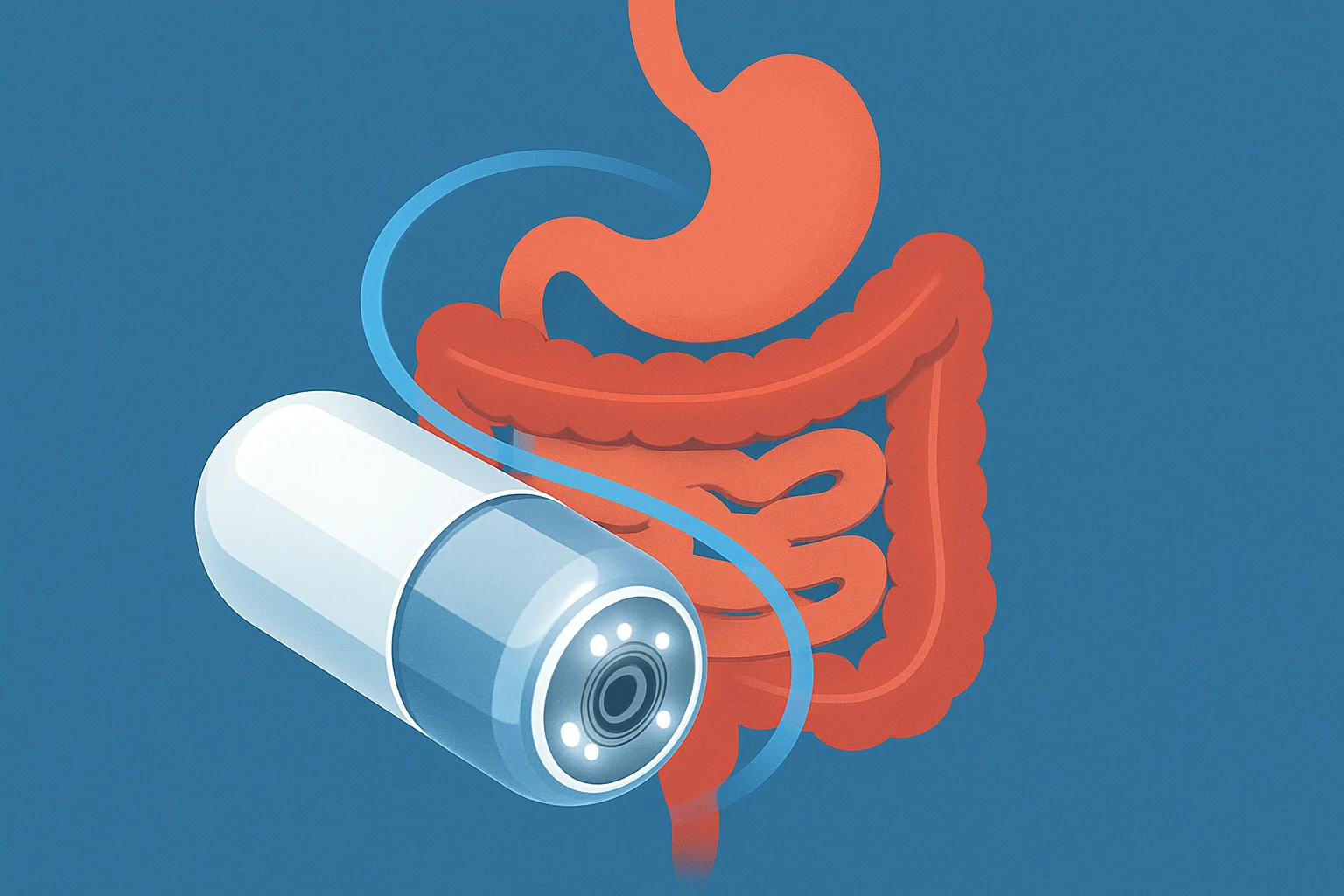
What is Capsule Endoscopy?:
Capsule endoscopy is a minimally invasive diagnostic test in which the patient swallows
a small pill-shaped camera that captures images throughout the small intestine.
It is used to investigate gastrointestinal bleeding, iron-deficiency anaemia, suspected
small-bowel Crohn’s disease, and other small-bowel abnormalities that cannot be reached
by standard endoscopy or colonoscopy.
Capsule Endoscopy is commonly used to evaluate:
• Unexplained gastrointestinal bleeding
• Iron-deficiency anaemia
• Suspected or established small-bowel Crohn’s disease
• Small-bowel tumours or polyps
• Vascular lesions (such as angiodysplasia)
• Unexplained abdominal pain in selected cases
How does it work?:
The patient swallows a capsule containing a miniature camera, light source,
and transmitter. As the capsule travels naturally through the digestive tract,
it captures thousands of images and sends them wirelessly to a recorder worn
on the patient’s body. The capsule is disposable and passes naturally in the stool.
The transmitted images are later reviewed by a gastroenterologist to identify
inflammation, bleeding, ulcers, polyps, or other abnormalities within the small intestine.
Conditions commonly detected by Capsule Endoscopy:
Vascular Lesions:
These include angiodysplasias—small dilated blood vessels in the small bowel—which are a frequent cause of chronic or intermittent GI bleeding, especially in older adults.
Crohn’s Disease:
Capsule endoscopy can detect early inflammation, ulcers, or strictures in cases of
suspected small-bowel Crohn’s disease when other imaging tests are inconclusive.
Small-Bowel Tumours and Polyps:
Although uncommon, small-bowel tumours (such as GISTs, adenocarcinomas, or carcinoids)
can be visualised by capsule endoscopy, especially when patients present with
unexplained bleeding or iron-deficiency anaemia.
Ulcers and Erosions:
The test can identify ulcers caused by NSAIDs, inflammation, infections,
or other underlying conditions not seen on standard scopes.
Symptoms and Signs:
Patients who benefit from capsule endoscopy may present with chronic anaemia,
occult blood in stool, unexplained abdominal discomfort, intermittent bleeding,
or symptoms suggesting inflammatory bowel disease. Many small-bowel lesions
cause intermittent or subtle symptoms.
Diagnosis:
If upper endoscopy and colonoscopy do not identify the cause of symptoms,
capsule endoscopy is often the next diagnostic step. In some cases,
other imaging such as MRI enterography, CT enterography, or deep enteroscopy
may complement the findings.
Treatment Guidance:
While capsule endoscopy is not a treatment procedure, its findings help guide
management—such as endoscopic therapy, medication adjustments, or further imaging.
It is highly valuable for mapping the extent of disease and planning targeted interventions.